There’d been a lengthy lull in conversation, but the instant I looked down at my open guidebook, 40-something Juan, the Director of Customs for the province of Manica, asked me yet another question about my family.As I began to explain when, and to whom, my younger sister got married, I glanced out the pick-up truck’s back window.Liam caught my eye and threw me a windswept wink.
Our hitchhike back to Beira went much faster than the journey there (the saved time mostly due to a lack of pointless 1 ½ hour stops).So I had to converse non-stop with our chatty kathy driver while Liam and Gavin lounged in the sunny, breezy truck bed?It was worth it!We knocked almost 6 hours off of our previous time traversing the EN1, and, in the end, when Liam asked if he could pitch in for gas, Juan looked at him, smiled and said, “I suspect not”, before driving away.Pretty good lift.
That morning, we’d awoken before dawn in Vilankulo, a bustling, dirty, little one-horse town in southern Mozambique.Glacier melt water coursed from the tap, disappointingly precluding a shower, so we simply packed up and jumped into the back of a crowded pick-up truck taxi, which brought us 12 miles to the EN1, Mozambique’s major North-South highway.In Pambara, more of a truck stop than a town, a grandmotherly woman kindly poured me some hot “agua” for tea, and we waited, watching a few little kids play a sand-throwy game of soccer.That was when Juan drove by, picked us up and sped the three of us northward.
Once in Inchope, the intersection village 3 hours west of Beira, I bought delicious muffins from a middle-aged woman who plainly thought the idea of selling my foreign self her wares was a hilarious, knee slapper of an event and would, without a doubt, spend the next few weeks telling friends and family, “Well, you’ll never guess what happened to me the other day…”
Liam, Gavin and I rode a maddening, stop-go-stop-go-stop-go-stop-go-stop-go minibus into Beira, which took forever. It was dark by the time we arrived and, at my pleading suggestion, we went out for a dinner of fresh prawns (the best I’d ever eaten) before heading back to the pleasantly familiar, Biques campground, setting up shop, and going to bed.
I checked my IPod clock: 5:48am.A little too early to get up, but the tent was light so I peeked out of the zippered window.The pale glow of an approaching dawn bathed both the sand and the sea in a blushing pink light.Six teenage boys waded in pairs, dragging between them, frayed, green fishing nets. I opened the door and as I turned to rouse Liam, a few hundred blood swollen mosquitoes bumbled out of the tent, sated with their nocturnal feast.I waved out as many as I could before kissing my boyfriend awake.Too sleepy to get up, he compromised by keeping the door open and loaning me his camera.I hopped outside, stretched tall, and walked delicately down towards the jetty where I climbed onto a rocky seat.Pastel pink bounced over the purple/grey/blue water and soon soft yellow rays danced into the mix as the sun peered eagerly upon the Indian Ocean.Laughing and sometimes singing, the young men hauled in their early morning catch.I breathed deeply and savored my beautiful, fortunate life.
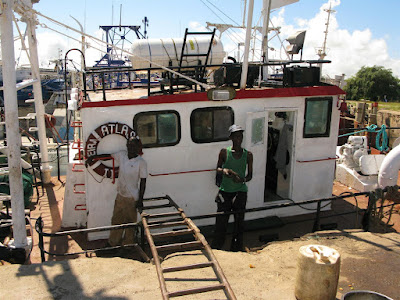
Later that morning, after a shower that was surprisingly warm, Liam, Gavin and I headed off to explore the city of Beira.We began our self-guided tour at Cafe Riviera where we chatted, drank coffee, and gobbled up mouth-watering pastries for breakfast.After that, we headed to the city’s port, meeting people and photographing the hundreds of docked fishing boats.A crazy guy followed us around for awhile either warning us of police or thinking we were police, it was impossible to decide.We appeared to be the only tourists in town, and aside from the one nut, everyone was pleasant and seemed happy we were interested in their country.
After an annoyingly long shop at the supermarket, we ate a few chicken pot pies for lunch on the curb outside Shoprite, and dropped Gavin off at a nearby internet cafe.Liam and I walked, hand in hand (despite humid heat), down every street and avenue that caught our fancy.I enjoyed talking to people in their local language.Well, not exactly, but Portuguese is pretty similar to Spanish, and from the moment we passed through Mozambiquen immigration, the Portuguese language had been music to my ears.I speak some Spanish, having lived for 2 years in Nicaragua, and though admittedly the languages are not quite as close as I would have hoped, I could still understand.Not everything, not even 50 percent, but at least 25 percent spoken and 50 percent written and that was an earful better than my Afrikaans or my Thai or my Shona or any local language I’d heard in the last 10 months.I relished each non-unintelligible word.
(Above: Tirana right?)
Part of Liam and my mission was to get my camera fixed.That is really our perpetual mission.Sand, rocketing around the Namib dunes has very sadly screwed with the focus mechanism, and even though the camera is a new, wonderful, Christmas gift from my mother, I can no longer use it.Liam, more knowledgeable about these things, is absolutely convinced it is salvageable.If only we could find a proper camera repair shop.Unfortunately, electronics in Southern Africa cost 4 times what they cost in the rest of the world, and people make way more than 4 times less money.The effect of this is that people neither own nor need to fix cameras; no camera shops.
One man we asked ushered us into his mechanics shop.Ahmed was a Muslim Arab who spoke English well, and was keen to try and clean out the camera with Liam.I nervously nodded my permission, and having been shown to a stool, sat and watched the two boys eagerly, carefully, disassemble one of my most prized possessions. Ahmed had a building full of tools, including tiny screwdrivers and an air compressor.After an hour, unable to deconstruct the device any further, the guys put it back together unfixed.The mechanic and the mechanical engineer were perhaps even more downhearted about the failure than I was.
We said goodbye and met back up with Gavin.He and Liam went back to the port while I figured out the public transportation back home.Chapas (or minivans) troll the city, going every which way, picking up passengers.After only a little trouble, and several kind, patient strangers, I found one going my way and made it back to the tent just as the sun began to set.I sat on the sand and watched the sky burn pink, orange, red and yellow.Spectacular.
A simple loaf of bread and can of veggies made dinner for us later, and we fell into a semi peaceful, semi mosquito ridden sleep, listening to waves break not 30 feet away from our beds.
Not exactly Savannah, not desert, the only mountains were distant, too many hills to be plains, but not enough trees to be forest.Rolling along a lonely paved road, squashed into the back seat of a minibus, I could have been almost anywhere.Ebony women in vividly colored sarongs carrying babies on their backs and baskets on their heads blurred by as we drove past a few grass roofed, round, mud huts.Well then, it would have to be Africa.Brightly painted Spanish colonial style cement buildings soon replaced the huts and I was distinctly reminded of Central America.To my knowledge however, Spain never colonized black Africa.The place I found myself then, was the former Portuguese colony of Mozambique.
Liam, Gavin and I had crossed the border from Zimbabwe an hour earlier on a hitchhike, and had been dropped off in the tiny town of Manica.We were immediately surrounded by waves of annoying locals trying to rip us off and helpful Zimbabweans attempting to get us on a bus for a fair price.Finally, for $1.66, we poured ourselves into the back seat of an overcrowded minibus.Direction East.
Whoomp.Whoomp.Whoomp skid!!We turned around and wailed unintelligibly in unison.The bus slowed to a halt and we pointed backwards.The three of us had been the only ones with luggage and the driver had eyed it thoughtfully before shoving the free-standing back seat forward a bit and stacking our backpacks in a 10 inch wide space.Well, the doors couldn’t quite close, so he roped their handles together, stood back, and called it good.
Fifteen minutes later, we stared helplessly at our baggage splayed out across the hot asphalt.When the driver roped everything back into place a second time, I crossed my fingers.
Arriving in Chimoio, we bought tasty bananas and tangerines for the ridiculously bargain basement price of $0.03 each.Suddenly, the women vendors crowding around pushed us aside.The entire street seemed to be running away as if their lives (or livelihoods) depended on it. Blankets of food were gathered up instantly.Bowls of oranges, chocolate wafers, Coca-Colas, and pineapples scurried by.Two policemen followed.It was a raid.These illegal merchants weren’t paying taxes and Mozambique’s version of Uncle Sam was after them.I was glad we’d already bought ourselves fruit.
Climbing on a less crowded, more expensive 3 hour bus to Beira, our day’s final destination, we had to argue with the crooked driver for 10 minutes as he tried to charge us an outrageous $1.79 each for our luggage.Two sweet Zimbabwean girls sitting in front of us informed me that the rate was $0.71 per bag, and no more.The girls helpfully advised us to get off the bus in feigned protest and it worked like a charm.The dishonest driver quickly dropped the fee to the norm, and I thanked the young women.
Buses outside the first world generally leave only when they are full, and this one was no exception.An hour after we boarded, we still sat waiting.Street vendors knocked interminably on the windows, selling hard boiled eggs, chips, soda, airtime, lottery tickets etc.Eventually, a man did stop by, selling nothing, though it took me awhile to notice his empty hands.Blessing, a Zimbabwean man in his late twenties, asked me where I was from and we proceeded to speak for 10 begging-free minutes.
The bus began to move and I waved goodbye to my new friend, hoping that he would soon be given some of his own namesake.Poor Zimbabweans, so educated, so polite, so civilized.One government, one man, one dictator, built and destroyed them all.
Soon, the land flattened out and both darkness and altitude fell.
At about 8:15pm, our bus deposited us and (happily/luckily) our bags in central Beira.Copious streetlights lining the wide avenues and a healthy number of people out and about gave us the pleasant feeling of safety.Beira seemed to me to be an amalgam of Central America and Eastern Europe.The craziness, smell, and colonial style buildings of Latin America enclosed upon massive, ugly communist bloc apartments.Mozambique’s history encompassed the mixture.
In search of sustenance, we located an empty, air conditioned, Indian restaurant.While slowly enjoying our spicy meal, our eyes and brains locked onto the Al Jazeera English news on TV.It’s a rarity and a pleasure to see global news while in our travel information quarantine.
An hour later we took a taxi to Biques campground.We were pleased to find it was even cheaper than indicated in the guidebook and right, right, right on the beach.We ran to the water’s edge and dipped our toes into the warm Indian Ocean before setting up the tents.Aside from me and Liam’s argument about how best to eradicate the zillion mosquitoes in our tent before bed (I adamantly refused to sleep with stinky, burning mosquito coils), it was a good night following a successful travel day.